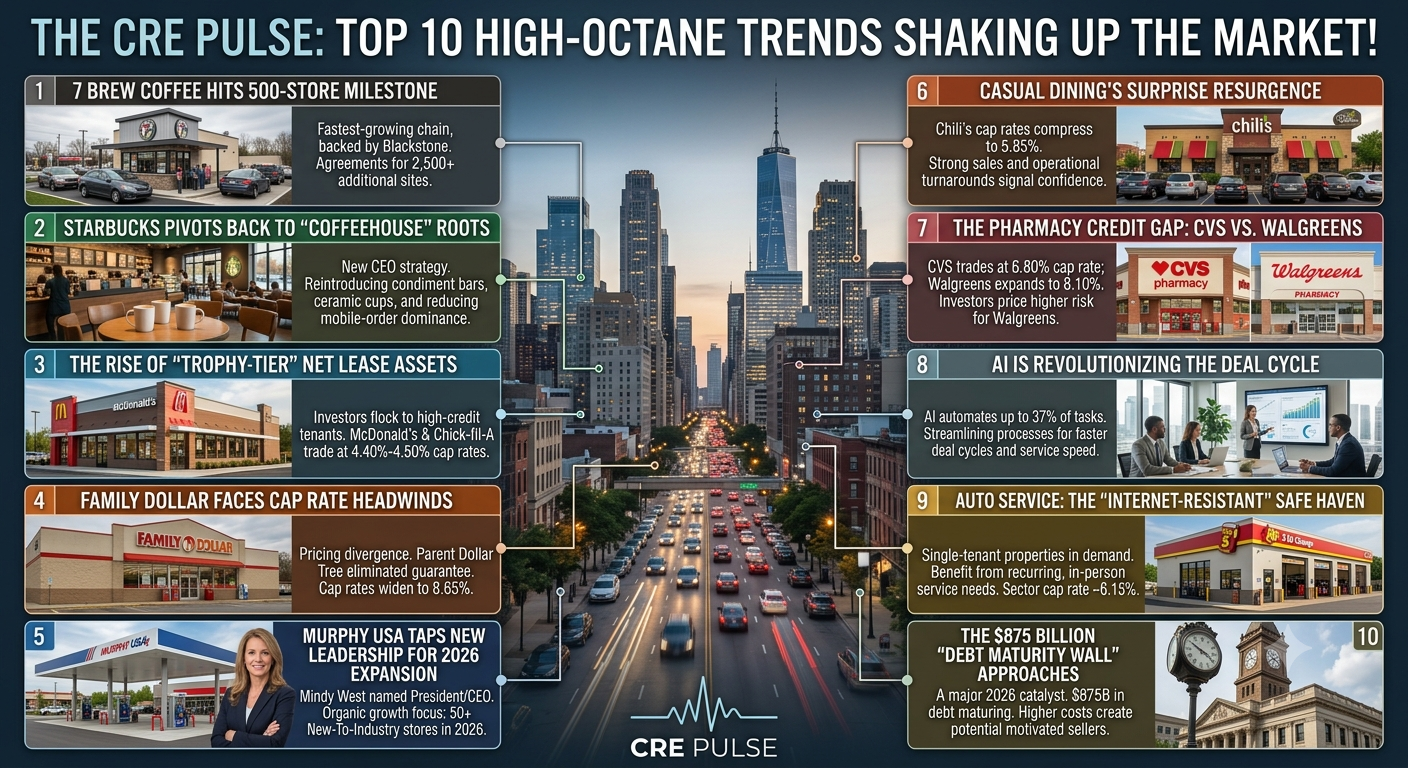
The commercial real estate (CRE) landscape is moving fast, with coffee giants, retail powerhouses, and tech-driven efficiency redefining how deals are done. From "trophy" assets to the surge of modular construction, here is your essential top 10 list of the latest news and trends currently shaping the industry.
1. 7 Brew Coffee Hits the 500-Store Milestone
The drive-thru coffee wars are heating up as 7 Brew Coffee began 2025 with 297 franchised restaurants and exited at 578. The franchise opened as many locations in 2025 as it did the previous two years combined . In 2026, 7 Brew has 437 projected new franchised outlets planned. The brand currently has more than 700 stands across 38 States with 2025 revenue exceeding $112 million.
See Faris Less 7 Brew Properties HERE
2. Starbucks Pivots Back to Its "Coffeehouse" Roots
Under the leadership of new CEO Brian Niccol, Starbucks is shifting its strategy away from mobile-order dominance to reclaim its identity as a "neighborhood coffeehouse". The brand plans to reintroduce ceramic mugs, more comfortable seating, and the return of coffee condiment bars by 2025. To fund these renovations and reach a four-minute throughput target, Starbucks is currently curtailing some new store development
3. The Rise of "Trophy-Tier" Net Lease Assets
Investors seeking maximum credit certainty are flocking to "trophy" tenants like McDonald’s and Chick-fil-A, which currently command the lowest cap rates in the net lease universe at 4.40% and 4.50% respectively. Wawa also remains a premier target for institutional capital; a recent North Carolina location traded for $5.55 million at a 5.29% cap rate.
4. Family Dollar Faces Cap Rate Headwinds
While the broader market stabilizes, the dollar store sector is seeing a significant divergence in pricing. Family Dollar’s cap rates widened by 15 basis points to 8.65% after its parent company, Dollar Tree, eliminated its guarantee for the brand in 2025. This shift has pushed some Family Dollar properties with short lease terms into "distressed territory" with cap rates reaching 9.50%
5. Murphy USA Taps New Leadership for 2026 Expansion
Convenience store giant Murphy USA is preparing for a new era, naming Mindy West as President and CEO effective January 1, 2026. Despite the leadership change, the company remains "steadfastly committed" to its organic growth strategy, aiming to open 50 or more "new-to-industry" (NTI) stores next year
See Faris Less Murphy USA & WaWa Properties HERE
6. Casual Dining’s Surprise Resurgence
Once considered a declining category, casual dining brands like Chili’s and Olive Garden were surprise top performers in early 2026. Driven by strong same-store sales and operational turnarounds, Chili’s cap rates compressed by 15 basis points to 5.85%, signaling renewed investor confidence in the sector.
7. The Pharmacy Credit Gap: CVS vs. Walgreens
The pharmacy sector continues to show a massive 130-basis-point spread between its two biggest players. While CVS trades at a 6.80% cap rate, Walgreens has expanded to 8.10%. Investors are pricing in higher re-tenanting risks for Walgreens, especially after the company went private in 2025, which reduced its financial transparency.
8. AI is Revolutionizing the Deal Cycle
Technology is no longer just a buzzword; it is a core operational strategy. Reports indicate that AI is now capable of automating up to 37% of real estate tasks, helping brokerages streamline the entire process from initial contact to closing. This shift is helping firms stay competitive in a market where "speed of service" is as important for brokers as it is for restaurant operators.
9. Auto Service: The "Internet-Resistant" Safe Haven
Single-tenant auto service properties, such as Take 5 Oil Change and Jiffy Lube, remain a top target because they are considered "internet-resistant". These tenants benefit from recurring, in-person service needs that cannot be digitized, leading to steady demand and a sector-wide cap rate of approximately 6.15%
10. The $875 Billion "Debt Maturity Wall" Approaches
A major catalyst for 2026 will be the massive $875 billion in commercial real estate debt reaching maturity. Because current borrowing costs are nearly double what they were at origination, many owners of high-quality NNN assets may be motivated to sell, creating unique opportunities for buyers to acquire strong, corporate-backed leases.